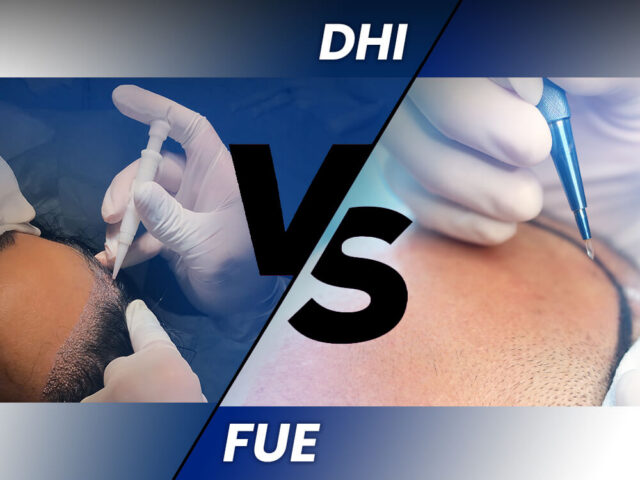
Both DHI and FUE are modern, minimally invasive methods. The right choice depends on the area to cover, desired density, hairline priorities, budget, and your donor characteristics. Below is a quick comparison to help you decide fast, followed by a deeper, evidence-backed guide.
| Feature | FUE | DHI | What It Means For You |
|---|---|---|---|
| Extraction method | Individual follicle extraction with a micro punch | Individual follicle extraction with a micro punch | Donor harvesting is similar in both |
| Implantation method | Grafts placed after creating recipient site incisions | No pre-made incisions – grafts implanted directly with Choi pen | DHI integrates channel creation into placement for tighter control |
| Healing time | Slightly longer due to recipient site incisions | Faster recovery – no pre-made incisions | Downtime is short with both, but DHI can heal faster |
| Precision in placement | May be less precise for angle and direction | More precise control of angle, depth and direction | DHI is often preferred for hairline artistry |
| Hair shaving requirement | Full head shaving is typically required | Does not require full head shaving | DHI can suit patients seeking less visible downtime |
| Graft number per session | Up to ~5,500 grafts | Up to ~4,000 grafts | For very large coverage needs, FUE may be more efficient |
| Density per cm² | Up to ~65 grafts/cm² | Up to ~80 grafts/cm² | DHI enables compact packing in strategic zones |
| Best suited areas | Covering larger areas | Smaller areas or higher density targets | Choose by goal: coverage vs concentrated density |
| Procedure duration | Shorter – steps are separate and streamlined | Longer – extraction and implantation occur simultaneously | Mega sessions are often faster with FUE |
| Typical cost in Turkey (4,000 grafts) | ~€3,000 | ~€3,850 | DHI is usually pricier due to tooling and chair time |
| At Estenove | €3,395 flat for both FUE and DHI – surgery, hotel, transfers, medications, PRP, aftercare | No per-graft surprises – package model | |
| Key dependence | Surgeon expertise, donor quality, atraumatic handling, correct sizing and spacing | Technique is the tool – planning and execution drive outcomes | |
1. DHI vs FUE – the real difference
Both techniques extract follicles individually with a micro punch. The main difference is implantation: FUE places grafts into pre-made channels, while DHI uses a Choi pen to implant directly. This integrated placement gives DHI precise control of angle, depth and direction, which is valuable for hairlines and dense packing. Pen-based implantation ensures shorter out-of-body time and gentler handling, both of which improve graft survival.1
2. FUE explained
What it is: Follicular Unit Extraction removes grafts one by one, then creates recipient channels sized to the grafts before placement. This is the foundation technique for broad coverage with tiny dot scars and efficient large sessions.2
3. DHI explained
What it is: Direct Hair Implantation uses Choi pens to place grafts directly without pre-made incisions. This offers fine control over angle, depth and direction, well suited to hairlines and small high-density zones. According to research on Direct Hair Transplantation (NCBI), placing grafts immediately helps reduce the time they stay outside the body, which can improve their survival.3
4. Who is a good candidate for each?
- FUE: Large balding areas, mid-high Norwood stages, when you need many grafts in one or two sessions.
- DHI: Smaller areas, hairline and temple peaks, when you want high density without full head shaving.
Whether you’re a good candidate also depends on your donor supply: Factors like hair density, strand thickness, skin type, and even hair-to-skin color contrast. These influence how difficult the surgery is and what kind of results can be achieved.4
5. Procedure steps – what actually happens
FUE
- Planning and anesthesia – painless option is available: Comfort-In hair transplant
- Micro punch extraction
- Recipient channels sized to grafts
- Implantation into channels
DHI
- Planning and anesthesia
- Micro punch extraction
- Immediate loading into Choi pens and direct implantation
Across both methods, key principles for better results are gentle (atraumatic) extraction, using the right punch size, keeping grafts outside the body for as little time as possible, and creating recipient sites that ensure proper blood supply and survival.2, 4
6. Prices and what drives cost
Hair transplant costs differ greatly across countries, mainly due to labor costs, clinic overhead, and currency differences. In high-income countries, prices are at the top end:
In comparison, Turkey averages for ~4,000 grafts are much more affordable: FUE and DHI generally ranges from €2,400–€3,850. The higher cost of DHI comes from the use of Choi implanter pens and the longer procedure duration.
At Estenove, both FUE and DHI are offered at a flat €3,395 all-inclusive package. This price covers surgery, hotel accommodation, airport transfers, medications, PRP, and aftercare. Unlike per-graft billing models used elsewhere, Estenove’s package approach eliminates hidden fees and keeps budgeting straightforward.
7. Recovery, comfort and aftercare
- Healing window: Around 7-10 days for both to settle. DHI may feel quicker because it avoids pre-made incisions.
- Comfort: Painless, new technology local anesthesia is used.
- Scars: Tiny dot scars in donor with both techniques.
- Aftercare: Follow washing, swelling control and activity restrictions exactly as advised.
Check out our full hair transplant recovery by month guide for more details.

8. Results, density and success factors
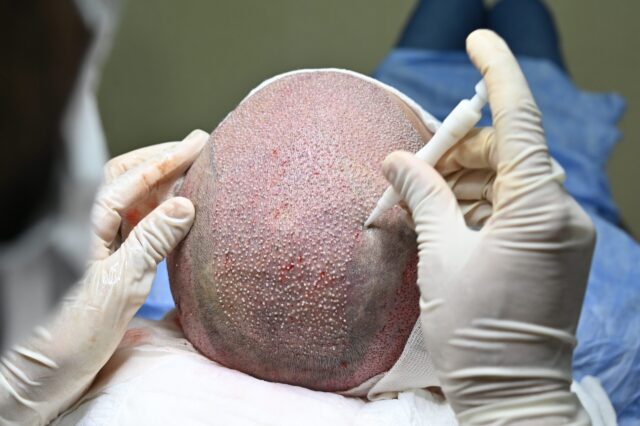
High-density results are achievable with careful planning. In practice, FUE typically allows up to ~65 grafts/cm², making it efficient for covering larger areas and achieving high total graft counts. DHI, on the other hand, can reach ~80 grafts/cm² in smaller, strategic zones such as hairlines and temple peaks, thanks to the precision of the Choi implanter pen.
Regardless of the technique, the most decisive factors remain surgeon expertise, donor quality, and meticulous graft handling, which strongly influence graft survival and natural-looking results.3, 4
9. How to choose between DHI and FUE
If your top priority is a hyper-natural hairline with compact density and you want to avoid full head shaving, DHI is usually preferred. If you need extensive coverage within one or two efficient sessions, FUE often makes more sense. The best choice comes from a personalized assessment that maps your donor supply to your goals.
10. FAQ
Is DHI always better for density?
It is excellent for hairlines and small zones, but final density depends on planning, donor and site sizing.
Which heals faster?
DHI can heal faster because it avoids pre-made incisions, but both typically settle within 7-10 days.
Which has higher graft survival?
Both methods can achieve high survival rates. Key factors are minimizing the time grafts spend outside the body (ischemia time) and handling them gently. DHI’s pen allows immediate implantation, which reduces ischemia time, while well-optimized FUE workflows also support excellent survival.
Can I avoid shaving?
DHI does not require full head shaving and select unshaven approaches are possible. Ask during consultation.
- Sethi, P., & Bansal, A. (2013). Direct hair transplantation: a modified follicular unit extraction technique. Journal of cutaneous and aesthetic surgery, 6(2), 100–105. https://doi.org/10.4103/0974-2077.112672
- Garg, A., & Garg, S. (2021). Overview of Follicular Extraction. Indian journal of plastic surgery : official publication of the Association of Plastic Surgeons of India, 54(4), 456–462. https://doi.org/10.1055/s-0041-1739244
- Umar, S., Shitabata, P., Rose, P., Carter, M. J., Thuangtong, R., Lohlun, B., Benhiba, H., Oguzoglu, T., Zollinger, M. M., Maldonado, J., Gonzalez, A., Novosilska, M., Gómez Zubiaur, A., & Marti, M. (2022). A New Universal Follicular Unit Excision Classification System for Hair Transplantation Difficulty and Patient Outcome. Clinical, cosmetic and investigational dermatology, 15, 1133–1147. https://doi.org/10.2147/CCID.S369346
- Wall, D., Meah, N., Fagan, N., York, K., & Sinclair, R. (2022). Advances in hair growth. Faculty reviews, 11, 1. https://doi.org/10.12703/r/11-1